


Why Employers Still Ask for It
Even in 2026, a huge share of job listings still list “high school diploma or equivalent” as the minimum requirement. It’s not because employers think a diploma teaches you everything you need. It’s a signal. It tells them you can show up, follow through, and finish something that takes years. That’s worth more to a hiring manager than people give it credit for.
Think about it from the hiring side for a second. A manager reading through fifty applications has no way to test everyone’s work ethic in an interview. A diploma is a shortcut for them. It says: this person stuck with something for four years, met deadlines, and passed required coursework. That’s not nothing. It’s one of the reasons entry-level roles in retail, logistics, healthcare support, and office administration almost always list it as a baseline requirement, even when the daily job itself doesn’t use algebra or literature analysis.
That said, a diploma by itself is rarely the finish line anymore. It’s the entry ticket. What you do after is what actually moves your income. The rest of this article is about exactly that: the two realistic paths for turning that entry ticket into a real income, and what the numbers say about each one.
The Part Nobody Tells You: A Diploma Is a Floor, Not a Ceiling
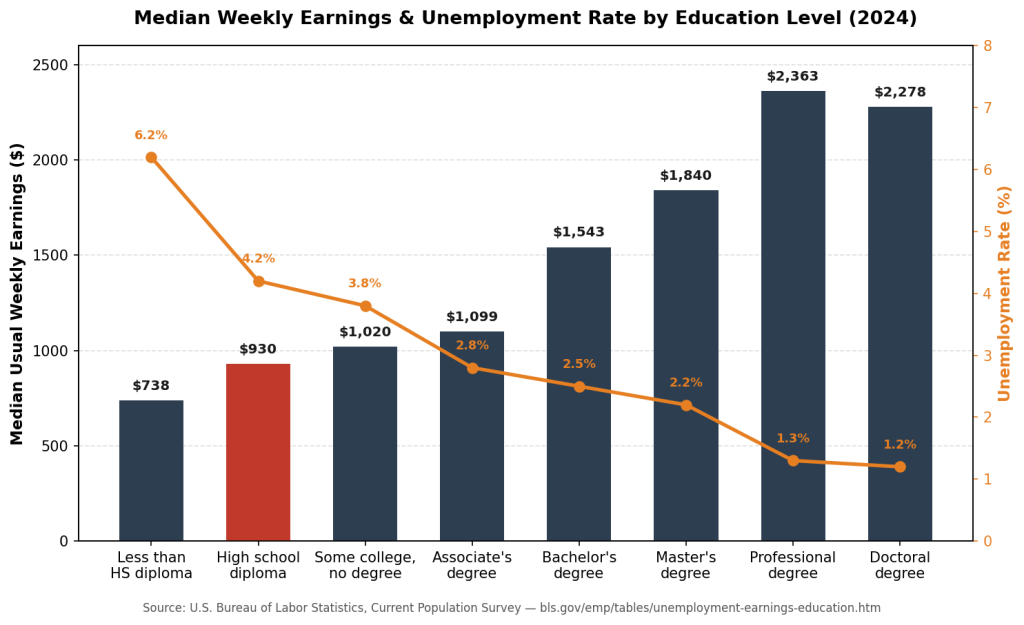
Here’s the part most articles skip over. Your diploma sets a floor under you. It doesn’t set a ceiling. What you stack on top of it is what decides whether you’re earning $48,000 a year or $103,000 a year.
I learned this one the hard way. I started out as a plumbing apprentice, not exactly the path people expect from someone who’d go on to write books about education. But that experience taught me something college brochures never mention: a diploma plus a real skill beats a diploma sitting alone every single time. I get into this a lot more in my book, The Pastor of the Student Loan Disaster, where I walk through how I built a career and a business without waiting around for anyone to rescue me from debt or hand me a shortcut.
Diploma vs. GED, Does It Matter Which One You Have?
Short answer: a little, but not as much as people assume. Most employers treat a GED and a diploma the same way on paper. Where it matters more is with the military and some competitive trade apprenticeships, which sometimes give preference to traditional diploma holders. If you’re choosing between finishing high school or leaving early for a GED, finishing tends to keep more doors open.
What Happens If You Stop There
If you get your diploma and stop, you’re not stuck. You’re just at the starting line instead of the finish line. The data backs this up: $48,360 a year is a livable income in a lot of places, but it’s not a lot of room for building wealth. That’s exactly why the next two sections matter so much.
The Trade Path: How Far a Diploma Plus a Skill Can Take You
This is the section that surprises people most. A lot of the highest-paying trade jobs in America only require a high school diploma to get started. No four-year degree. No six-figure loan. Just a diploma, an apprenticeship, and a willingness to learn.
Highest-Paying Trades That Only Require a High School Diploma
| Trade Career | 2024 Median Annual Wage | Typical Entry Requirement |
|---|---|---|
| Elevator & Escalator Installers/Repairers | $106,580 | High school diploma + apprenticeship |
| Power Plant Operators, Distributors & Dispatchers | $103,600 | High school diploma + on-the-job training |
| Electrical Power-Line Installers (Linemen) | $92,560 | High school diploma + apprenticeship |
| Telecommunications Technicians | $64,310 | High school diploma (certificate preferred) |
Source: U.S. Bureau of Labor Statistics, Occupational Outlook Handbook (2024 data)
Read that elevator installer number again. $106,580 a year, median, with just a diploma and an apprenticeship to get in the door. That’s higher than the median pay for most bachelor’s degree holders nationwide.
If this trade route sounds interesting, I’ve gone deep on this exact topic before in tired of college debt? try a trade skillset, and in how trades are returning to high schools as more schools wake up to this reality.
Real Earning Comparison: Diploma-Only vs. Diploma + Trade
Someone with just a high school diploma is earning around $48,360 a year, based on the BLS median. Someone who takes that same diploma and adds a trade apprenticeship in a field like elevator repair or power line work can more than double that number, often within four to five years, and without taking on college-level debt to do it. That’s not a small gap. That’s a completely different financial life.
The College Path: When It’s Worth Stacking a Degree on Top
None of this means college is a bad move. It means college should be a deliberate move, not an automatic one.
Look back at the earnings table. A bachelor’s degree holder earns a median of $80,236 a year, which is real money. Where people get hurt isn’t the degree itself. It’s the way they pay for it.
Where a Bachelor’s Degree Still Creates Real Gains
Fields tied to healthcare, engineering, technology, and finance tend to see the strongest return on a four-year degree. If your goal genuinely requires a licensed or degree-gated profession, like nursing or engineering, a diploma and a trade apprenticeship won’t get you there. College is the right tool for that specific job.
The mistake isn’t picking college. The mistake is picking a specific degree without checking whether that degree actually leads to a job that pays enough to justify its cost. Before you commit to a major, it’s worth spending a weekend looking up real starting salaries for that exact degree, not the general “college grads earn more” headline number. The gap between a well-chosen major and a poorly-chosen one can be tens of thousands of dollars a year, which matters far more than whether you went to college at all.
How to Do It Without the Debt Trap
This is where most of the damage happens, not in choosing college, but in overpaying for it. I reduced my own college costs by 40% using strategies like living on campus as an RA for free housing, going the community college route first, and being deliberate about scholarships instead of just accepting loan offers. I break the entire step-by-step process down in Chadwick’s College Checklist, if you want the exact playbook.
If tuition costs are part of what’s holding you back from deciding, this breakdown on rising college costs is worth reading before you commit to anything.
So Which Path Is Right for You?
There’s no universal right answer here. But you can narrow it down fast by asking yourself four questions:
- Does the career I want legally require a degree? (Nursing, engineering, law — yes. Elevator repair, power line work, HVAC — no.)
- Can I stomach 4-5 years of apprenticeship-level pay before the six-figure trade wage kicks in?
- Am I willing to go the community-college-first, scholarship-heavy route to avoid heavy debt, if I choose college?
- Do I want to build something of my own instead of working for someone else right out of the gate?
If that last question is where your head’s at, it’s worth reading should students build a business before they graduate before you settle on any single path.
Your diploma doesn’t lock you into one lane. It just gets you onto the highway. Where you drive from there is up to you.
About Charles A. Chadwick Jr.
Charles A. Chadwick Jr. is a financial literacy educator, author, and entrepreneur who transformed his path from plumbing apprentice to published thought leader. He reduced his college expenses by 40% while earning two degrees and successfully managed student loans without relying on forgiveness programs. Charles is the author of four books, including The Pastor of the Student Loan Disaster and Chadwick’s College Checklist, and has been featured in Associated Press News, Reader’s Digest, and Realtor.com, among others. His work and story have also been covered by Good Men Project, Advisor Perspectives, Patch, and JDNews, with additional pieces on new construction home-buying appearing on Realtor.com, including guides on pros and cons and common myths. His mission is to empower students and families to achieve financial freedom through strategic education choices.

One Comment