
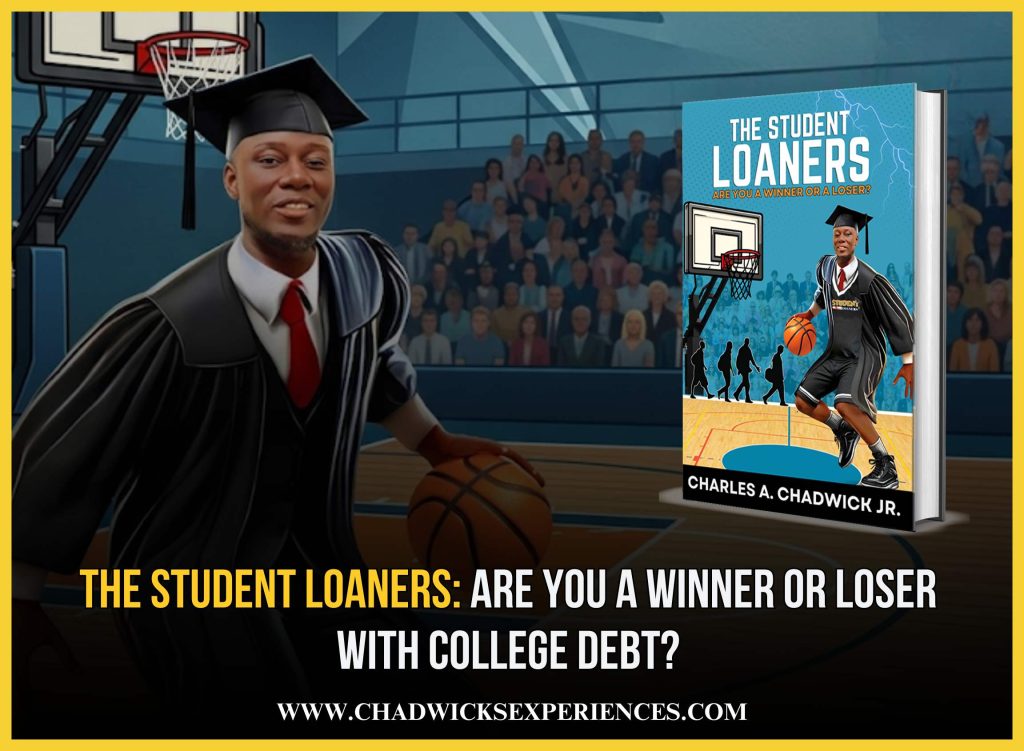
The Student Loaners: Are You a Winner or Loser With College Debt?
Let’s be real. Most students sign a college loan contract without fully understanding what they just agreed to. No playbook. No game plan. Just a signature and a hope that it all works out.
That is exactly how people lose.
But here is the good news. This is a game you can win. You just need to know the rules before you step on the court.
What Is a Student Loaner?
You have heard the term “student loan.” But “student loaner?” Probably not.
A student loaner is any individual who has taken the leap to sign a college student loan contract. The moment you put your name on that dotted line, you are in the game whether you are ready or not.
And just like basketball, the outcome depends entirely on how you play.
“Basketball has players, but college has Student Loaners.” — Charles A. Chadwick Jr.
This is the core idea behind Charles’s book, The Student Loaners: Are You a Winner or Loser?
The book is built on one powerful truth: navigating student debt is a strategic game, and every single move you make matters.
Free Tip from The Student Loaners Book:
The Court Is Set. Here Is What You Are Agreeing To.
When you sign a student loan contract, three things become your responsibility immediately. Most students skip over these details. Winners do not.
Repayment Is Non-Negotiable
It does not matter if you finish your degree or drop out after one semester. The borrowed amount must be repaid.
There are no timeouts for “life happened.”
This is one of the most important rules of the game and one of the least talked about.
Interest Is the Opponent You Cannot Ignore
Student loans accrue interest. That means the amount you owe can grow over time, even while you are still sitting in class.
Federal loans typically carry fixed interest rates. Private loans can vary, sometimes significantly. Knowing the difference before you sign is a game-changing move.
For a deeper breakdown on this, check out our article on student loan high interest rates and whether consolidation makes sense for your situation.
Read More: Student Loans High Interest Rates – Should You Consolidate?
Terms and Conditions Are Your Rulebook
Every loan agreement comes with:
A repayment schedule
Penalties for missed payments
Borrower benefits and conditions
Ignoring the fine print is like stepping on the court without knowing the rules.
You will lose.
Read everything before you sign, and if something is unclear, ask questions until it is not.
Why Do Students Become Loaners in the First Place?
Nobody takes out a student loan just for fun.
There are real reasons people end up here, and understanding them is the first step to making smarter decisions.
Some of the biggest reasons include:
Rising tuition costs
Limited scholarship opportunities
Belief that a degree guarantees better income
Lack of alternative education pathways
For many students, loans feel like the only option available.
But here is something worth asking:
Is a loan always the right move?
Charles built his entire career challenging that assumption.
Starting as a plumbing apprentice, he went on to earn two college degrees while reducing his total education costs by 40%. He managed and paid off his student loans without relying on forgiveness programs.
Sometimes the smartest play is questioning whether you need to be on this court at all.
Read our article on whether student loans are truly a headache or an alternative pathway to think through your options.
Read More: Student Loan Headache or Alternative Pathway?
The Winner’s Mindset. Playing the Game Like a Pro.
Here is where the basketball framework from The Student Loaners gets truly powerful.
Think of your loan repayment like a live game:
The shot clock is always running
Every missed payment is a turnover
Every extra payment toward principal is a point on the board
Your Grace Period Is Pre-Game Warmup. Use It.
After graduation, many loans offer a grace period before repayments begin.
Not all loans include this benefit, so confirm with your lender.
If yours does have a grace period:
Build your budget
Organize repayment plans
Understand your monthly obligations
Prepare financially before payments begin
Do not use this time to pretend the debt does not exist.
Research Your Interest Rate Before You Sign
Federal loans often carry fixed interest rates. Private loans vary by lender.
This single detail can determine how much you pay back over the life of the loan.
Always compare your options before committing. Always.
Think About Future Earnings Realistically
Before taking on debt, consider the earning potential in the field you are entering.
If the projected income does not support the debt load you are about to carry, that is important information.
It is not pessimism. It is strategy.
The Buzzer Beater Mindset
In basketball, the buzzer beater is the clutch shot that changes everything.
In your financial life, that clutch move might be:
Making an extra payment
Refinancing at the right time
Choosing an income-based repayment plan
Avoiding unnecessary borrowing
With the right guidance and strategy, you can face your debt with determination instead of dread.
The Loser’s Trap. Waiting for a Rescue That May Never Come.
Waiting for student loan forgiveness as your primary strategy is one of the most common losing moves out there.
Forgiveness programs have been:
Uncertain
Delayed
Blocked
Revised repeatedly
Building your financial future around policy outcomes you cannot control puts you in a passive position when you need to be playing offense.
Curious about where forgiveness programs actually stand right now? We break it all down in our article on whether student loan forgiveness will actually happen.
Read More: Will Student Loan Forgiveness Happen?
Charles’s message has never changed:
You do not need loan forgiveness. You need a better plan.
Also worth reading if someone else is asking you to co-sign a loan. Saying no can be one of the most powerful financial decisions you ever make for both yourself and the student. Read More: Student Loan Co-Signing: Why Saying No Can Be the Best Gift for Students
Get the Full Playbook
If you want the complete game strategy — not just tips, but a full framework for thinking about student loans differently — The Student Loaners: Are You a Winner or Loser? is the book built for exactly that.
Charles uses basketball as the lens because sports teaches what classrooms often skip:
Time management
Resilience
Strategy
Performing under pressure
Those same skills apply directly to how you handle your student debt.
The book is available now on Amazon. Get “The Student Loaners” on Amazon
And if you are still in the planning phase trying to figure out how to minimize what you borrow before you even start, Chadwick’s College Checklist covers the exact strategies Charles used to cut his own college costs by 40%. Get “Chadwick’s College Checklist”
Key Takeaways
A student loaner is anyone who signs a student loan contract.
You are responsible for repayment whether you graduate or not.
Interest grows over time, and understanding your rate matters from day one.
Use your grace period to prepare, not to avoid.
Do not build your financial future around forgiveness as a primary plan.
The right playbook changes everything.
FAQs
A student loaner is any person who signs a college student loan contract. Once you sign, you are legally committed to repaying the borrowed amount with interest, regardless of whether you complete your degree.
No. Federal student loans typically come with fixed interest rates, structured repayment options, and government-backed protections. Private loans vary by lender and can carry higher or less predictable interest rates. Understanding this difference before borrowing is critical.
Yes. Your repayment obligation is tied to the loan contract itself, not to whether you complete your degree. This is one of the most important details students overlook before signing.
A grace period is the window of time after graduation before repayments are required to begin. Not every loan includes this, so confirm with your lender. If you have one, use that time to prepare financially instead of delaying repayment planning.
No. Because forgiveness programs can change politically and legally, relying on them as your primary repayment strategy is risky. A proactive repayment plan puts you in a much stronger financial position.
You have greatly impressed me! Up until now, I don’t believe I’ve ever read anything even remotely like to it. I am very happy to have found someone with some original thoughts on this topic. To tell the truth, I appreciate you starting this. The internet is searching for someone with a little bit of imagination, and this website is just what someone needs!
Thank you for your kind words and for joining our Chadwick’s Experiences community! We’re delighted to have you as a follower and appreciate your support in sharing our content on social media. Stay tuned for more exciting posts in the future, and feel free to share any topic suggestions you may have. Your support means a lot to us!