

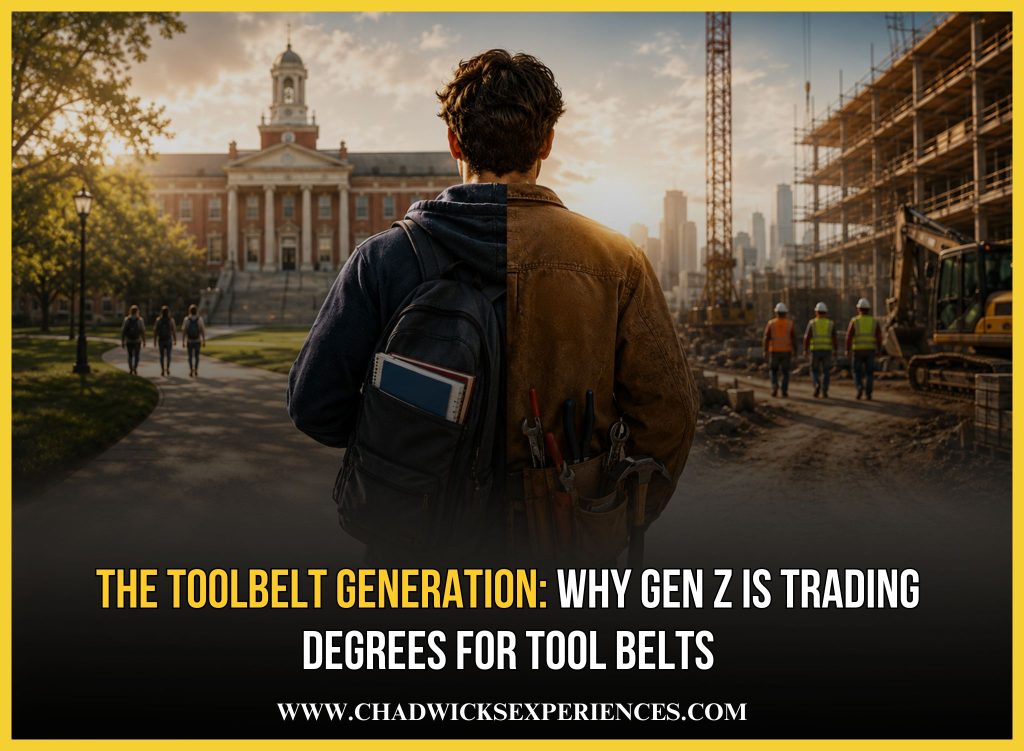
There is a new nickname making the rounds in career circles, and it is not flattering to the old four-year playbook.
They are calling this generation the “Toolbelt Generation.”
Not because Gen Z suddenly fell in love with copper wiring or PVC pipe. Because they ran the numbers, watched AI eat entry-level office jobs on the news, and decided a tool belt looks like a safer bet than a diploma with a six-figure price tag attached.
More than half of Gen Z workers, about 53%, say they are seriously considering blue-collar or skilled trade work. That is not a fringe opinion anymore. That is a majority.
I have spent years writing about student debt, degree returns, and whether you should seek loan forgiveness or jump into a trade apprenticeship. But this shift is different from the trade school vs. college debate I have covered before. This one is not really about cost. It is about fear of a very specific kind. The fear that a degree costing hundreds of thousands of dollars might not even survive the four years it takes to earn it.
Let us break down what is actually happening, why it is happening now, and whether jumping on the toolbelt bandwagon makes sense for you.
What Is the Toolbelt Generation?
The Toolbelt Generation refers to the wave of Gen Z workers choosing skilled trades over traditional four-year degrees, largely out of concern that white-collar jobs are more exposed to AI automation than hands-on trade work.
The term has been picked up by everyone from the Wall Street Journal to Fox News to Mike Rowe, who has spent a decade campaigning for exactly this shift. What used to be a slow and steady drift toward vocational programs has turned into something closer to a stampede.
This is not nostalgia for the trades. It is risk management.
Why Gen Z Is Walking Away From the Degree-First Path
Walking away from the traditional college route is a massive decision, and it is not one this generation is making lightly. There are three major forces actively pushing young adults away from the lecture hall and pulling them toward the job site.
The AI-Proofing Instinct
Ask a Gen Z worker why they are eyeing a trade instead of a cubicle, and the answer increasingly comes back to one word: AI.
In a recent 2025 Gen Z Reroute Report covering a nationally representative survey of 1,000 Gen Z workers, 65% said a college degree will not protect them from AI-related job loss. A separate October 2025 survey dug into the “why” and found something even sharper. Among Gen Z workers who see blue-collar jobs as more secure than office jobs, 80% pointed to AI-proofing as the main reason.
Think about what that means. This generation is not asking “will I get a job after graduation.” They are asking “will my job still exist by the time I graduate.” That is a different question, and it is one their parents’ generation never had to seriously consider.
As we explored in our deep dive on why AI proves skills beat degrees in 2026, a plumber fixing a burst pipe under your kitchen sink is not getting automated next year. A junior analyst summarizing spreadsheets might be.
The Labor Shortage Pulling Them In
While Gen Z is pushing away from one door, the trades are actively pulling them through another.
Industry estimates from groups like the National Center for Construction Education and Research put the number of construction workers expected to retire by 2031 at around 41%. That is not a shortage brewing quietly in the background. That is a wave of open positions, higher wages, and faster advancement for anyone willing to show up and learn the work.
It is also exactly why the Bureau of Labor Statistics notes that a large share of projected trade openings in fields from electrical work to HVAC come specifically from workers retiring or leaving the field, not just new job growth.
Fewer experienced hands aging out of the workforce means more openings, less competition, and companies fighting to train and retain young talent instead of ghosting their applications.
The Debt Math Nobody Wants to Say Out Loud
I have written before about how the true cost of a degree rarely matches what students are told at orientation. The Toolbelt Generation has done that math earlier than most, and they do not like what they see.
A four-year degree can run well past six figures once you count tuition, housing, and fees. The College Board puts the total four-year cost at roughly $124,000 for an in-state public school and up to $262,000 at a private university, before factoring in years of lost income while you are not earning a paycheck.
A trade credential typically costs a fraction of that, and many apprenticeships pay you while you train instead of the other way around.
That difference compounds fast. A four-year degree can start you in debt before your first day of work. A paid apprenticeship can start you with a paycheck instead.
The Numbers Behind the Shift
The data backs up what feels like a vibe shift on social media.
- Trade school enrollment grew 4.9% from 2020 to 2023, while traditional university enrollment declined 0.6% over the same span, according to an analysis of National Center for Education Statistics data.
- Electricians alone held about 818,700 jobs in 2024, and the U.S. Bureau of Labor Statistics projects that number to grow 9% through 2034. This is much faster than the average for all occupations, with roughly 81,000 openings a year.
- Wall Street Journal reporting and industry commentary have both pointed to real jumps in vocational program enrollment in construction, HVAC, and related trades over the past several years.
This is not a rumor spreading on TikTok. It is a measurable redirection of an entire generation’s career plans, and the government’s own labor data confirms the demand is real.
Not Every Trade Is Created Equal
Here is where I want to slow down, because going into the trades is not one piece of advice. It is dozens of different career paths with very different outlooks.
Trades with strong projected demand and substantial hands-on work per BLS 2024-2034 projections:
- Electricians: There is a 9% projected growth with about 81,000 openings a year. The work is physical, hands-on, and tied to buildings and infrastructure that cannot be virtualized.
- HVAC Technicians: There is an 8% projected growth with about 40,100 openings a year. Climate systems require in-person diagnosis and repair that cannot be done remotely.
- Lineworkers: There is a 7% projected growth with about 10,700 openings a year. The people who keep the power grid running are not getting replaced by a chatbot.
- Plumbers: There is a steadier 4% projected growth but still about 44,000 openings a year. Every building with running water needs one, and none of that work happens remotely.
That is what the government demand data shows. The automation-risk read is my own analysis layered on top. Work that requires physically being in a specific place and touching a specific pipe or panel tends to be harder to automate than desk-based, repetitive knowledge work.
Where the picture is murkier:
Not every tech-adjacent role is automation-proof. Roles that are heavy on scheduling, paperwork, drafting, or basic diagnostics are already seeing AI tools creep in as assistants. The physical, on-site troubleshooting work is what is holding up best. The desk-adjacent parts of any trade are the parts most likely to shrink over time.
The lesson is to pick a trade based on how much of the job happens with your hands in the actual space, and not just because the word “trade” sounds automation-proof by default.
The Trade-Offs Nobody Talks About
I am not going to stand here and tell you the trades are a magic bullet, because they are not.
Trades come with real physical demands that a desk job does not. Some trades have earnings ceilings that top out lower than a strong corporate career track. Licensing and apprenticeship requirements vary wildly by state, and not every program is well run.
And here is the part that matters most to me. A debt-free path still requires financial literacy. Trading student loan debt for bad money habits later is not a win. It is just a different version of the same problem. This is exactly why we constantly remind young people that not having financial knowledge is worse than not having money.
The Toolbelt Generation is not smart because trades are automatically better than college. It is smart because they are finally asking the return on investment question early instead of four years and $80,000 too late.
How to Actually Start
If this is resonating, here is the practical path forward and not just the theory.
- Research the specific trade, not just the category. Skilled trades cover everything from welding to elevator repair. Look at your local job market, not just national averages.
- Compare apprenticeship vs. trade school vs. certification. Apprenticeships often pay you from day one and eliminate tuition entirely. Trade schools move faster but usually cost money upfront. Certifications can be the quickest entry point for specific tech-adjacent trades.
- Talk to people already doing the job. Not a recruiter. Not a school marketing page. Someone five years into the actual work who can tell you what the job is really like on a Tuesday in February.
- Treat your first paycheck like a launchpad, not a finish line. Debt-free is a huge head start. Do not waste it by skipping the financial literacy piece that got so many degree-holders into trouble in the first place.
A Real-World Lesson From the Trades
I wrote Chadwick’s Cultivated Circumstances for exactly this moment, years before the Toolbelt Generation was a headline.
The core idea of that book is simple. Hands-on experience often builds more real financial security than waiting around for a credential or a minimum wage bump to save you. That is not a theory I read somewhere. It is the path I walked myself, from a plumbing apprenticeship to where I am now.

If the shift you are reading about here feels like it is speaking directly to you, that book goes deeper into how to actually build a stable future through trade and hands-on paths, without pretending the trade-offs do not exist.
Final Thoughts: Run Your Own Numbers
The Toolbelt Generation is not rejecting ambition. They are rejecting a specific bet. The one that says a four-year degree guarantees a return no matter the major, the cost, or the state of the job market by graduation day.
More than half of Gen Z is now willing to pick up a tool belt instead of a diploma, and the labor data backing that decision—from retiring trade workers to real wage growth—suggests they are not wrong to look twice.
Do not choose a path because it is trending. Choose it because you ran your own numbers and it holds up. That is the whole point.
About the Author
Charles A. Chadwick Jr. is a financial literacy educator, author, and entrepreneur who transformed his path from plumbing apprentice to published thought leader. He reduced his college expenses by 40% while earning two degrees and successfully managed student loans without relying on forgiveness programs. Charles is the author of four books, including The Pastor of the Student Loan Disaster and Chadwick’s College Checklist, and has been featured in Associated Press News, Reader’s Digest, and Realtor.com, among others. His work and story have also been covered by Good Men Project, Advisor Perspectives, Patch, and JDNews, with additional pieces on new construction home-buying appearing on Realtor.com, including guides on pros and cons and common myths. His mission is to empower students and families to achieve financial freedom through strategic education choices.


3 Comments