
Table of Contents

Every few months, America gets another big student loan headline.

One court makes a ruling. One agency changes a rule. One senator sends a letter demanding answers.

Millions of borrowers feel relief. Millions of others feel confused.

This month, it happened again.

A federal appeals court ruled that the U.S. Department of Education must move forward with wiping out student loans for a large group of borrowers under a long-running legal settlement. It is real news, and it matters. But it also raises a bigger question that matters even more:

Why are so many families counting on loan forgiveness before they even finish college?

That question is exactly why Chadwick’s Experiences exists. Our mission has never been “don’t go to college.” Our mission has always been “know exactly what you’re signing before you sign it.” Because once the diploma is framed and hanging on the wall, the monthly payment starts anyway.

Quick Answer

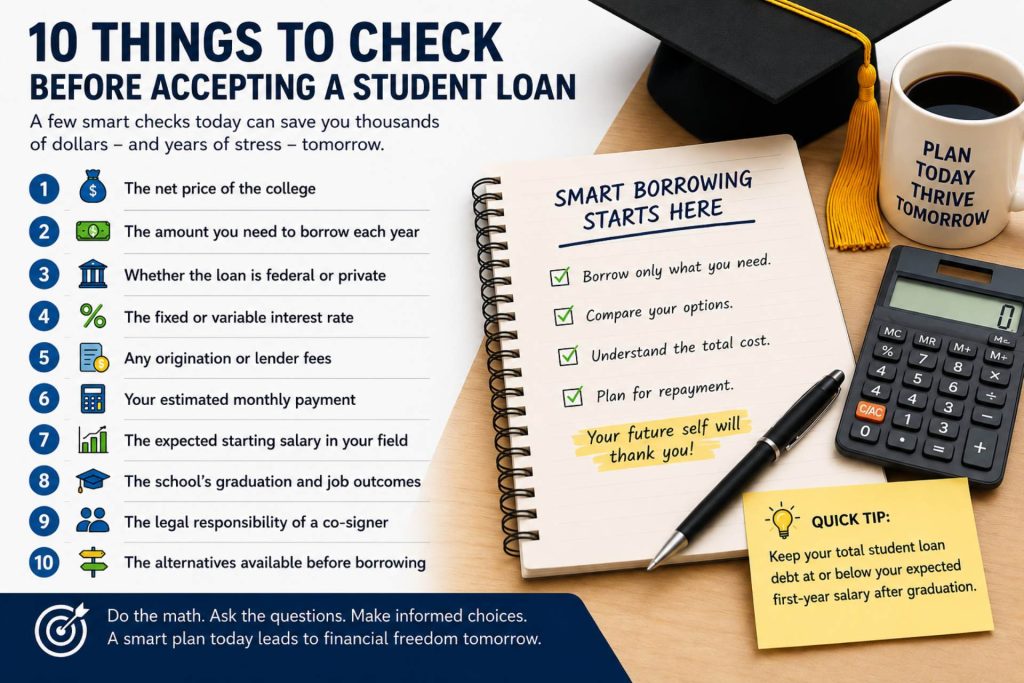
  • Set a hard borrowing cap: Never borrow more in total student loans than your realistic first-year salary after graduation.
  • Focus on Net Price: Compare net price (after grants and scholarships), not the sticker price colleges advertise.
  • Prioritize free money: Apply for scholarships, grants, and work-study before taking out any loan.
  • Know the numbers upfront: Know your exact interest rate and monthly payment before you sign — not after.
  • Plan for reality: Don’t build your repayment plan around the hope of future forgiveness.

Why This Matters Right Now

Court rulings on student debt can feel like background noise. They come and go. But they are a good reminder of something every student and parent should sit with before senior year even starts.

Student loans are a financial contract that can follow you for decades. The rules around forgiveness change depending on who is in the White House, who is in Congress, and what a judge decides on any given Tuesday. Your obligation to pay does not change with the news cycle.

We recently broke down the bigger policy shifts hitting borrowers this year in our piece on how the 2026 student loan rules are changing. This article goes one step further back — to the decision families make before any loan paperwork gets signed at all.

The Court Ruling Everyone Is Talking About

Let us get the facts straight, because a lot of headlines are blurring them together.

What the Ruling Actually Covers

On July 17, 2026, the Ninth Circuit Court of Appeals rejected the Department of Education’s request to delay relief under the Sweet v. McMahon settlement. This settlement goes back to 2022 and covers borrowers who say their schools — mostly for-profit colleges — misled them about jobs, accreditation, or graduation rates. In total, the settlement covers more than 500,000 borrowers, and this specific July ruling forces the Department to move forward on discharges for roughly 170,000 of them — a group called “post-class applicants” whose claims sat unresolved past the settlement’s deadline.

Who Is Actually Included

Here is the part that matters most: this is not general student loan forgiveness. It is relief tied to a specific legal settlement about school misconduct. If you did not attend one of the named schools and file a borrower defense claim, this ruling does not apply to your loans at all.

What It Means If You Are Not Covered

If you are not part of this settlement, nothing about your repayment plan, your interest rate, or your forgiveness eligibility changed because of this ruling. That is the point worth remembering. Big headlines about “500,000 borrowers” can make forgiveness feel a lot closer and a lot more universal than it actually is.

Meanwhile, lawmakers are still fighting over the bigger picture. In July 2026, members of Congress introduced new legislation focused on accreditation reform and holding schools accountable for student outcomes and debt. Whatever side of that debate you land on, the lesson for families is the same: policy in Washington moves slowly, but your loan payment doesn’t wait for it.

College Is an Investment: Treat It Like One

If someone wanted to buy a small business, they would ask a lot of questions first. What does it cost? What is my return? How long until I break even? What happens if it doesn’t work out?

Very few families ask those same questions before borrowing $30,000, $60,000, or more for a college degree.

Questions to Ask Before Taking Out a Student Loan

Most high schoolers spend months picking a dream school, a major, and a dorm. Very few spend even one afternoon researching:

  • The interest rate on their loans
  • What their monthly payment will actually be
  • What their expected starting salary is in that field
  • How many years it will take to pay the loan off

Return on Investment, Explained Simply

Your degree is an investment. So is a trade certification. So is an apprenticeship. The question isn’t “is college good or bad.” The question is: does this specific path, at this specific cost, make financial sense for your life?

That is a big part of what I cover in my book, Chadwick’s College Checklist, where I walk through exactly how I cut my own college costs by 40 percent — before I ever had to ask that question the hard way. If schools taught this kind of math earlier, families would make very different decisions. It is a gap we dig into in why schools don’t teach money management.

How Much Does a Student Loan Really Cost?

Numbers on a loan document can feel abstract. They stop feeling abstract the moment your first bill shows up.

Principal, Interest, and Monthly Payments in Plain English

Here is how it works in plain terms:

  • Principal is the amount you actually borrow.
  • Interest is the extra cost you pay for borrowing it.
  • Your monthly payment covers a mix of both, spread out over your repayment term — usually 10 years for a standard federal plan.

For loans first disbursed after July 1, 2026, the federal interest rate for undergraduate Direct Loans is 6.52 percent, up slightly from 6.39 percent the year before. That may not sound like much. Here is what it looks like in real dollars.

Sample Loan Repayment Comparison (10-Year Standard Plan at 6.52% Rate)

Amount BorrowedEstimated Monthly PaymentEstimated Total Repaid
$10,000~$114~$13,637
$30,000~$341~$40,910
$60,000~$682~$81,821

Note: These figures are rounded estimates for federal undergraduate Direct Loans at the current fixed rate and a standard 10-year term. Your actual payment depends on your loan type, disbursement date, and repayment plan.

Notice something? On every one of these, you end up repaying well beyond what you actually borrowed. That is not a trick. That is just what interest does over time.

Federal vs. Private Loans: Know the Difference

Federal loans come with fixed rates, income-driven repayment options, and borrower protections. Private loans are set by individual lenders, often require a credit check or co-signer, and usually offer far fewer safety nets if you fall on hard times.

FeatureFederal Student LoansPrivate Student Loans
Interest RateFixed, set by Congress each yearFixed or variable, set by the lender
Credit CheckNot required for most federal loansUsually required, often needs a co-signer
Forgiveness ProgramsAvailable (PSLF, borrower defense, etc.)Not available
Income-Driven RepaymentAvailableRarely offered
Hardship ProtectionsDeferment and forbearance optionsVaries widely by lender

Quick Fact: The Undergraduate Federal Direct Loan rate for the 2026–27 academic year is 6.52% (up from 6.39% the prior year) and is fixed for the life of the loan.

Parent PLUS loans deserve their own mention here. For the 2026–27 year, the rate on Parent PLUS loans jumped to 9.07 percent, plus an origination fee of over 4 percent taken right off the top. Before any parent signs one of these, they should compare it carefully against every other option first. The Consumer Financial Protection Bureau also offers free tools for comparing loan offers side by side.

Before You Sign: The Pre-Borrowing Checklist

Print this out. Sit down with your financial aid award letter. Go through it line by line before you sign anything.

Questions to Ask the Financial Aid Office

  • Is this aid renewable every year, or is it a one-time award?
  • What happens to my aid package if my academic standing changes?
  • What is the total net cost after grants and scholarships — not the advertised sticker price?
  • How much of my financial package consists of loans versus non-repayable free money?

Net Price vs. Sticker Price

Colleges love to advertise their sticker price. Almost nobody pays it. What matters is your net price — the amount left after grants, scholarships, and financial aid. Two schools with wildly different sticker prices can end up costing the same family the exact same amount. Always compare net price, not the number on the brochure.

Warning Signs You Are Borrowing Too Much

Watch for these red flags before signing your loan agreement:

  • Your total expected debt is close to or higher than your realistic starting salary.
  • You are borrowing the maximum offered “just in case,” without a documented financial need.
  • You have not checked your school’s official graduation and job placement rate for your major.
  • You are relying on future loan forgiveness as your main repayment strategy.

The rules around federal loan repayment and servicing keep shifting — including recent changes to how loans are managed at the federal level. We covered some of that instability in our piece on how student loan management is moving between federal agencies. None of that instability is a reason to panic. It is a reason to plan like the rules might change, because they usually do.

Should Parents Co-Sign?

This is one of the most emotionally loaded questions in the whole process. Every parent wants to help. Not every parent understands what they are actually agreeing to.

What Co-Signing Legally Means for You

When you co-sign a loan, you are not just vouching for your child. You become legally responsible for that debt if they cannot pay it. It appears on your credit report and directly affects your ability to borrow — for a car, a home, or personal needs — for years to come.

Parent PLUS Loan Risks

Parent PLUS loans put the debt entirely in the parent’s name, at a higher rate than standard federal student loans, with fewer flexible repayment options. Before signing one, ask yourself honestly: Can I afford this payment on top of my own retirement savings and existing obligations?

We go much deeper on this exact decision in why saying no to co-signing can actually be the best gift you give your student. Saying no to a loan isn’t saying no to your child’s future. Sometimes it is the exact opposite.

Alternatives Worth Exploring Before You Borrow

College isn’t the only road to a successful career. It is one of several paths, and it is not always the fastest or the cheapest one.

Skilled Trades and Apprenticeships

According to the U.S. Bureau of Labor Statistics, the median annual wage for electricians was $62,350 — and most electricians reach that level through a paid apprenticeship, not a four-year degree loaded with debt. Plumbers and HVAC technicians see similar earnings. These are careers people can train for while earning a paycheck instead of accumulating debt.

Path Comparison: College vs. Trade vs. Community College Transfer

PathTypical Time Before Full WagesTypical Debt LoadWhat You Gain
4-Year University (Direct)4 yearsOften $20,000–$60,000+Broad career options, higher long-term ceiling in select fields
Community College → Transfer4–5 yearsSignificantly lowerSame bachelor’s degree at a fraction of the total cost
Trade / Registered Apprenticeship1–4 years (Paid Training)Minimal to noneFaster entry into the workforce, strong median wages, licensed skillset

Note: Figures are general ranges based on published BLS and industry wage data. Individual results vary by field, location, and institution.

None of this means trades are inherently “better” than college. It means they deserve a real seat at the table when your family is doing the math. I wrote The Pastor of the Student Loan Disaster for exactly this reason — my own path went from plumbing apprentice to published author, and neither step was a mistake. We explore this further in why a trade skillset can be a smart move against college debt.
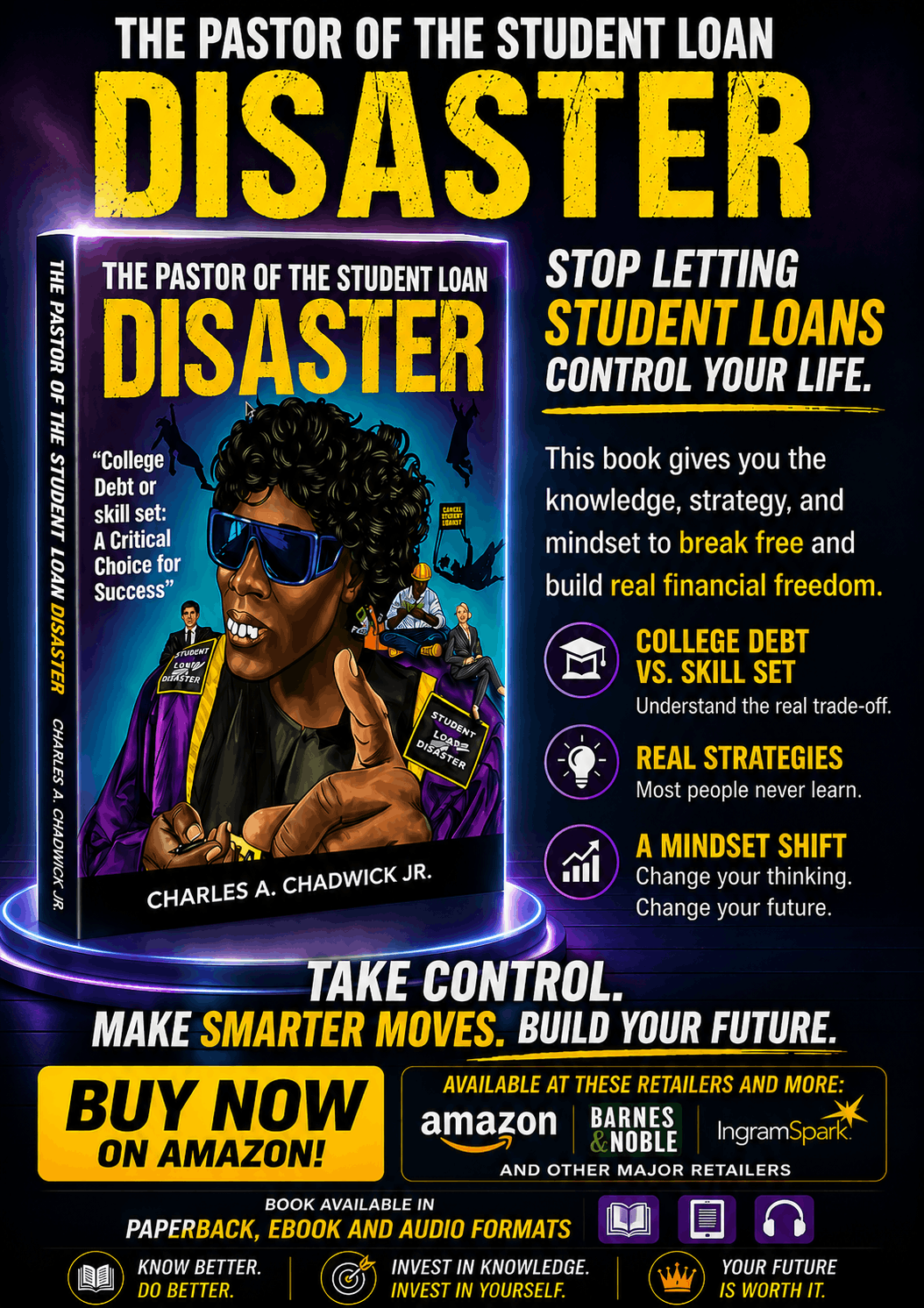
Promotional graphic for "The Pastor of the Student Loan Disaster" by Charles A. Chadwick Jr., a book focused on achieving financial freedom by analyzing the critical trade-off between acquiring college debt versus building a skill set. The banner encourages readers to stop letting student loans control their lives and notes its availability on Amazon and Barnes & Noble.

Don’t Build Your Financial Plan Around Forgiveness

Here is the hardest truth in this entire article.

Cancellation vs. Forgiveness vs. Discharge

These terms are often used interchangeably, but they have distinct legal definitions:

  • Discharge typically applies to specific hardship or legal circumstances — such as school closures, disability, or institutional fraud (as seen in the Sweet v. McMahon case).
  • Forgiveness usually applies to specific, program-based relief after meeting explicit service requirements, such as Public Service Loan Forgiveness (PSLF).
  • Cancellation is broader policy-driven debt relief often tied to specific government initiatives or legislative acts.

Why the Rules Keep Changing

Programs get created, challenged in court, and modified by new legislation. We have tracked this shifting landscape closely, including in our analysis of whether student loan forgiveness will actually happen.

Regardless of politics, the practical advice remains the same as outlined in my book The Student Loaners: Are You a Winner or a Loser?: approach your loans like a strategic game you control, not a gamble on external policy changes.

Key Takeaways

The recent court ruling is major news, but its direct impact is limited to specific borrower groups. For everyone else, the core lesson remains: don’t build your financial future around the expectation of debt relief. Build it on understanding your loan agreement before signing it.

  • Ask the hard financial questions early.
  • Compare net price instead of advertised sticker price.
  • Evaluate every education pathway — university, community college, trade school, apprenticeship — with objective financial planning.

That philosophy guides everything we do at Chadwick’s Experiences, and shapes our approach to learning, earning, and thriving at every step of your journey.

Learn. Earn. Thrive.

About Charles A. Chadwick Jr.

Charles A. Chadwick Jr. is a financial literacy educator, author, and entrepreneur who transformed his path from plumbing apprentice to published thought leader. He reduced his college expenses by 40% while earning two degrees and successfully managed student loans without relying on forgiveness programs. Charles is the author of four books, including The Pastor of the Student Loan Disaster and Chadwick’s College Checklist, and has been featured in Associated Press News, Reader’s Digest, and Realtor.com, among others. His work and story have also been covered by Good Men Project, Advisor Perspectives, Patch, and JDNews, with additional pieces on new construction home-buying appearing on Realtor.com, including guides on pros and cons and common myths. His mission is to empower students and families to achieve financial freedom through strategic education choices.

Charles A. Chadwick Jr. - Author and financial literacy expert

FAQs

It is a July 17, 2026 federal appeals court decision requiring the Department of Education to move forward with loan discharges for borrowers covered by a 2022 legal settlement over school misconduct. It affects a specific group of borrowers, not all federal student loan holders.

A common financial rule of thumb is keeping your total student loan debt at or below your expected first-year starting salary after graduation. If your estimated borrowing exceeds that number, consider lower-cost options before taking on additional loans.

Parents should thoroughly evaluate the legal and financial commitment before co-signing, as co-signers are fully responsible for repayment if the primary borrower defaults. It is important to compare Parent PLUS loans with alternative financing and evaluate how payments fit into long-term retirement planning.

Discharge applies to specific conditions like school closure or fraud. Forgiveness relates to structured programs requiring qualifying payments and service. Cancellation refers to broader legislative or administrative debt relief efforts.

Students can minimize debt by applying for non-repayable grants and scholarships, completing general education credits at a community college before transferring, evaluating net price over sticker price, and utilizing work-study programs.

Yes. Skilled trades offer paid, on-the-job apprenticeship training, low to zero debt, and competitive median wages according to BLS data. Choice of path depends on long-term career interest and financial goals.

Ask for the final net cost after financial aid, calculated monthly repayment obligations, fixed interest rates, aid renewal criteria, and average starting salaries for graduates in your chosen program.

A college degree can be a sound investment if the total cost aligns with post-graduation earning potential. The financial return depends on the choice of major, total debt incurred, and institutional net pricing.

Charles A. Chadwick Jr.

Charles A. Chadwick Jr. is an author, speaker, and entrepreneur who shares insights on financial literacy and career growth. His journey from plumbing apprentice to business owner serves as an inspiration for achieving financial independence.

Leave a Reply