
How Lenders Calculate Loans in Deferment or Forbearance
Here’s a detail that trips a lot of people up. What happens if your student loan shows a $0 payment on your credit report because it’s deferred or in forbearance?
Under Freddie Mac’s updated guidance, effective September 2025, if your student loan payment shows as $0, including on income-driven repayment plans, lenders calculate your monthly obligation as 0.5% of your total outstanding loan balance for DTI purposes. So, if you owe $40,000 in deferred student loans, lenders will typically count around $200 a month against your DTI, even if you aren’t actually paying anything yet.
That’s an important number to know before you start house hunting.
How Repayment Plans Can Work in Your Favor
If you’re on an income-driven repayment plan, most major loan programs allow lenders to use your actual, documented monthly payment instead of that flat 0.5% estimate. If your real payment is lower than the estimate, that can shrink your DTI and open up more borrowing power.
This is one more reason to understand your repayment options before you apply for a mortgage, not after.
Big Student Loan Changes Are Here in 2026
This next part matters if you or your kids are about to borrow for college.
Starting July 1, 2026, a new federal law changes several things about student loans. Grad PLUS and Parent PLUS loans are going away for new borrowers. New annual and lifetime borrowing limits are kicking in for graduate and professional students. And the older repayment plans, including SAVE, PAYE, and ICR, are being phased out in favor of a new Repayment Assistance Plan that sets payments at 1% to 10% of income depending on how much you earn.
Why does this matter for homeownership? Because your repayment plan directly affects your DTI, and your DTI directly affects how much house you can buy. The rules of the game are changing and understanding them before you borrow puts you years ahead of someone who finds out the hard way.
I go much deeper into these 2026 changes, and what they mean for anyone about to sign a student loan, in my breakdown of the new student loan rules for 2026.
This is exactly why I wrote Chadwick’s College Checklist. It gives students and parents a step-by-step way to reduce college costs and avoid debt mountains before rules like these even come into play. If you’re heading into 2026 without a plan, that book is a good place to start.
My Own Story — I Owned a Home While I Had Student Loans
I want to be direct about something. This isn’t theory for me.
I personally owned a home while I was still carrying student loan debt. Those loans made things more complicated. They affected my monthly cash flow. They were part of my debt-to-income ratio. But complicated and impossible are two quite different things.
In an earlier article, Owning a Home with Student Loans: Overcoming Barriers and Building Wealth, I walked through the exact strategies I used, including building credit, reducing other debt, saving consistently, and understanding what I could realistically afford before I ever talked to a lender.
If you’re worried that your student loans have closed the door on homeownership, they haven’t. You just need to understand the numbers.
Mortgage Programs That Work with Student Debt
Good news. You have more options than you might think.
Conventional loans, like Fannie Mae’s HomeReady or Freddie Mac’s Home Possible, allow down payments as low as 3% for qualifying borrowers.
FHA loans, backed by the Federal Housing Administration, allow a credit score as low as 580 with 3.5% down, or a score as low as 500 with 10% down.
State and local down payment assistance programs exist in nearly every state, often aimed specifically at first-time buyers. Many offer grants or forgivable loans toward your down payment and closing costs.
It’s also worth knowing that the median age of a first-time homebuyer in America is now 38, according to the National Association of Realtors. If you’re in your late 20s or 30s and still paying off student loans, you’re not behind some imaginary schedule. You’re right on pace with everyone else.
Don’t Wait Until You’re 30 to Learn What DTI Means
Here’s a pattern I see over and over.
You’re 18. You sign student loan paperwork. You graduate. You start working. Years pass. Then you’re ready to buy your first house, and suddenly someone starts talking about your debt-to-income ratio like you’re supposed to already know what that means.
Why are we waiting until someone wants to buy a house to teach them this? Why not explain DTI, credit, and interest before the student loan even gets signed?
That’s the type of financial education students need, years before graduation, not years after.
Parents: Have the “House Conversation” Before Signing Student Loans
Parents play a huge role here.
Before your child takes on real student loan debt, sit down together and treat it like you’re buying a house. Ask what the total cost will be for all four years, not just year one. Find out how much scholarship and grant money is available. Get the real number on how much you’ll actually need to borrow, and at what interest rate.
Ask what the monthly payment might look like after graduation and compare that to what the career typically pays. Ask if there’s a cheaper way to reach the same destination. Community college transfer programs can knock tens of thousands of dollars off a four-year degree without sacrificing the diploma.
The dream school is still worth chasing. It just needs a financial plan attached to it.
10 Questions to Ask Before You Sign a Student Loan
Print this list. Sit down with it before anyone signs anything.
- What will this education cost from start to finish?
- How much scholarship and grant money can we get first?
- How much will we actually need to borrow?
- What interest rate applies to that debt?
- What could the monthly payment look like after graduation?
- What is the expected starting salary for this career?
- Is there a less expensive path to the same career?
- How could this debt affect my future debt-to-income ratio?
- Could these payments affect how much house I can afford later?
- Does this decision still make sense 5, 10, or 20 years from now?
If you can’t answer these questions yet, that doesn’t mean don’t go to college. It means gather more information first. My article on what to know before taking out student loans in 2026 walks through each of these in more depth.
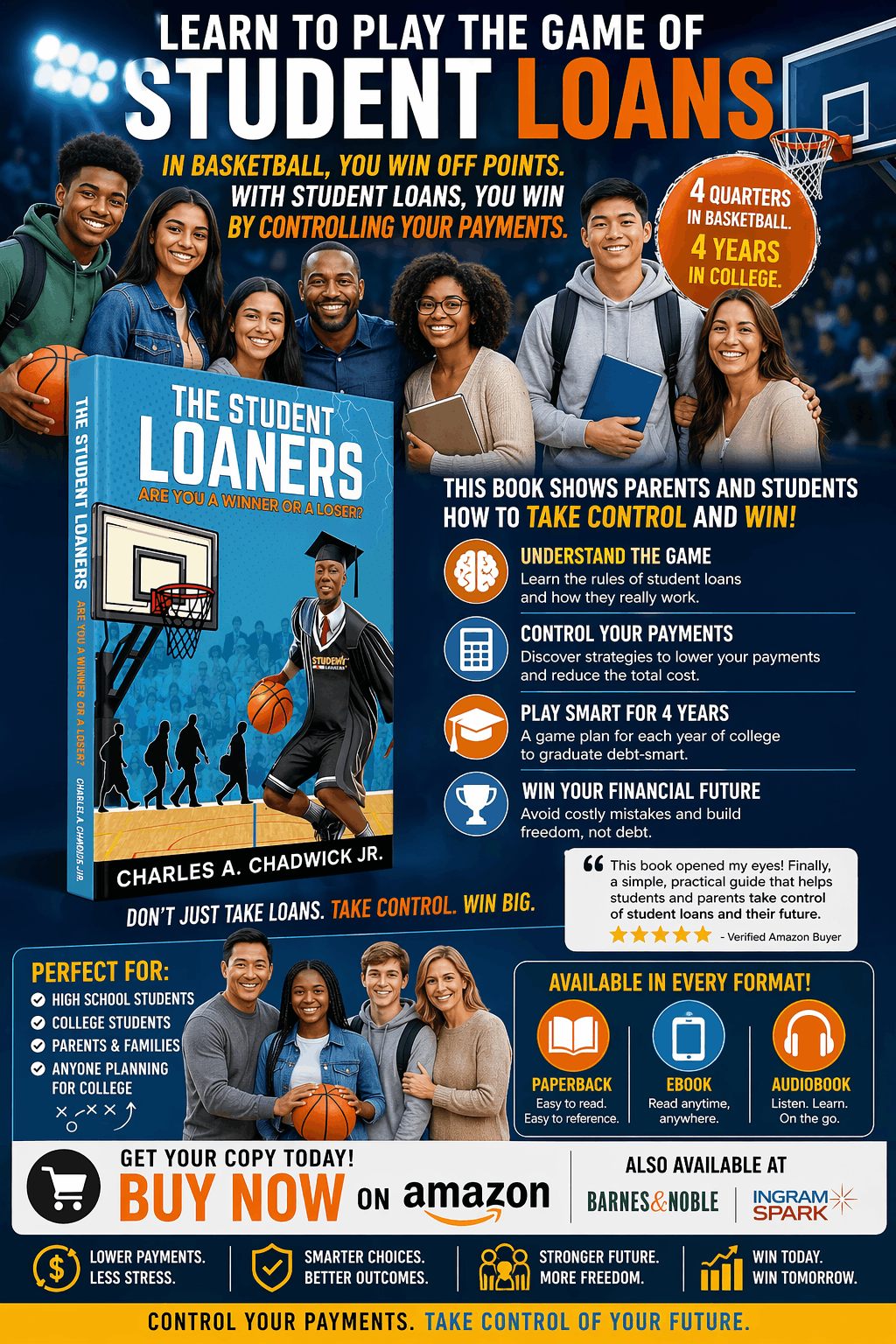
If you want a strategic framework for thinking through debt like it’s a game you can actually win, that’s exactly what I built in The Student Loaners: Are You a Winner or Loser? — using basketball strategy to explain how to play smart with student debt instead of just reacting to it.
The Duality Mentality, Why One Pathway Isn’t Enough
At Chadwick’s Experiences, I call this the Duality Mentality for the Economy.
College degrees can work. Trade skills can work. Entrepreneurship can work. None of these paths cancel each other out. The strongest position is often a combination, like a degree paired with a skill, or a trade paired with a side business.
Don’t limit yourself to one road. Understand your options, understand your finances, and build a path that actually fits your life.
L.E.T. — Learn. Earn. Thrive.
The philosophy behind everything I teach comes down to three words.
Learn your options before you decide. College costs, trade careers, salaries, credit, and DTI, all before you owe a dollar.
Earn by building real skills and experience, not just collecting a diploma without a financial plan attached to it.
Thrive by using what you’ve learned and earned to create real choices, like homeownership, investing, entrepreneurship, and helping the next generation do the same.
I go much deeper into this framework in Learn, Earn, and Thrive: The New Blueprint for Success Nobody Taught You in School.
So, Is College Still Worth It?
That’s not really a question with one answer.
The better question is: is this specific education, at this specific price, financed this specific way, worth it for this specific student? One person might graduate with almost no debt thanks to scholarships. Another might combine college with a trade. Another might skip college entirely and build a career through an apprenticeship.
I dig into this question from every angle in Is College Worth It? How to Decide If a College Education’s Value Matches the Price.
Success doesn’t have one address, and it definitely doesn’t have one degree.
Final Thought: There Is Nothing to Fear, but the Finances Must Be Clear!
The 2026 CNBC data shows a challenge. College costs are climbing, and families are stretching to keep up.
But I don’t want your takeaway to be fear. I want it to be financial education. My own experience taught me that student loans don’t automatically close the door on homeownership. I owned a home while I had student loans, and I understand both sides of this conversation: the value of education, and the weight of the debt.
Understand the numbers before college. Understand the debt before borrowing. Understand your DTI before applying for a mortgage. One financial decision does not have to erase every other dream you have.
College can be possible. Homeownership can be possible. Building wealth can be possible. It starts with knowledge, planning, and financial clarity, not waiting for the finances to sort themselves out.
Learn. Earn. Thrive.
Ready to build your own plan? Start with Chadwick’s College Checklist, or follow along on Instagram @reducecollegedebt for more strategies like this.
About Charles A. Chadwick Jr.
Charles A. Chadwick Jr. is a financial literacy educator, author, and entrepreneur who transformed his path from plumbing apprentice to published thought leader. He reduced his college expenses by 40% while earning two degrees and successfully managed student loans without relying on forgiveness programs. Charles is the author of four books, including The Pastor of the Student Loan Disaster and Chadwick’s College Checklist, and has been featured in Associated Press News, Reader’s Digest, and Realtor.com, among others. His work and story have also been covered by Good Men Project, Advisor Perspectives, Patch, and JDNews, with additional pieces on new construction home-buying appearing on Realtor.com, including guides on pros and cons and common myths. His mission is to empower students and families to achieve financial freedom through strategic education choices.

