

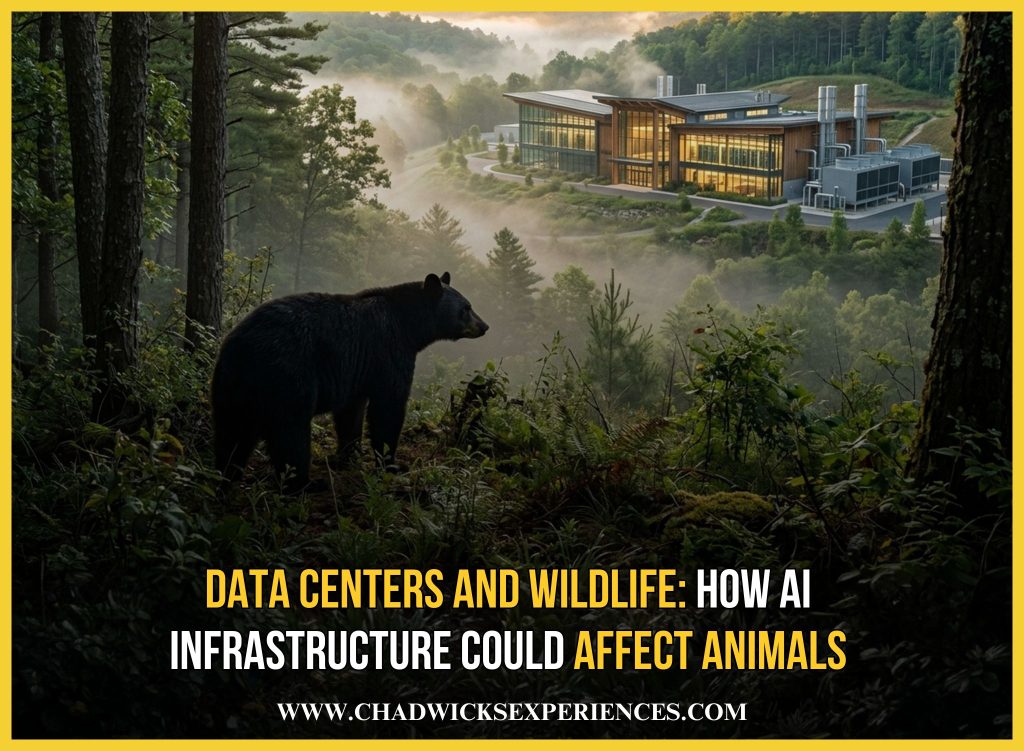
Data centers are powering artificial intelligence, cloud computing, and the digital economy—but as massive facilities spread across the United States and around the world, a less discussed question is emerging: What happens to the animals that were already there?
Artificial intelligence may live in the cloud; however, the physical infrastructure powering it is very much on the ground.
In addition, behind AI applications, cloud services, online searches, streaming platforms, and digital transactions are physical computing systems, many of which rely on servers housed inside data centers. Those servers require land, enormous amounts of electricity, cooling equipment, and, in many facilities, significant amounts of water.
Furthermore, as demand for computing power grows, communities are increasingly debating the economic, energy, and environmental consequences of data center construction.
But there is another stakeholder that cannot attend zoning meetings, hire attorneys, or speak at public hearings:
Wildlife.
From habitat conversion and water withdrawals to continuous mechanical noise, artificial lighting, and increased industrial activity, the rapid expansion of data centers raises an important environmental question:
Are we considering what happens to animals when digital infrastructure moves into their habitat?
Consequently, recent research suggests this question deserves considerably more attention.
Direct Answer: Yes, data centers can affect wildlife through land clearing, habitat fragmentation, localized water consumption, continuous industrial noise, and artificial night lighting. The extent of the ecological impact depends heavily on facility location, cooling technology, energy sources, site design, and mitigation safeguards implemented during construction.
Key Takeaways
- Multiple Environmental Pressures: Data centers can affect wildlife through land clearing, habitat fragmentation, water consumption, continuous noise, and artificial night lighting.
- Location and Technology Matter: Environmental impacts vary significantly depending on geographic location, local water stress, cooling methods, and facility design.
- Ecosystem Planning Matters: Wildlife corridors and ecosystem health should be considered during early site selection and municipal planning, before ground is broken.
- Skilled Trades Can Help Deliver Solutions: HVAC technicians, electricians, plumbers, and engineers are essential to constructing lower-impact, water-efficient, and sound-dampened facilities.
- Progress and Stewardship Can Coexist: Responsible development does not require choosing between technology, jobs, and environmental protection—it requires smarter design.
A Personal Experience That Made Me Think Differently About Wildlife
At Chadwick’s Experiences, many of our conversations focus on college, skilled trades, financial education, careers, and helping the next generation understand that there is more than one pathway to success.
However, sometimes an unexpected experience makes you think about something completely different.
That happened to me while I was on vacation visiting family in Tennessee.
During the trip, I noticed wildlife seemingly everywhere. Being around the mountains, cabins, and natural surroundings gave me an opportunity to see animals in an environment very different from what many of us experience in our everyday lives.
An Unexpected Wildlife Encounter in Tennessee
Then I had an encounter I did not expect.
A bear came onto the porch of our log cabin and helped himself to some of my cousin’s grilling supplies—and even his bourbon.
Yes, the bear apparently had expensive taste.
I had purchased bear spray as a precaution. Therefore, when the bear eventually came back toward the cabin, I sprayed a small amount in its direction to shoo it away.
At that moment, my concern was simple: Get the bear away from us and the cabin.
However, after the experience was over, I started thinking about it differently. In fact, I actually felt bad.
The question that stayed in my mind was: Was the bear coming into our space—or were we staying in his?
That question changed the way I looked at the encounter.
The cabin was built in an environment where bears and other wildlife had lived long before tourists arrived, roads were constructed, or vacation homes were built. The bear did not understand property lines. He did not know we paid to stay there. Moreover, he did not know that the porch belonged to somebody.
He was simply being a bear.
And that experience made me think about something much bigger.
Animals Have a Right to Be Here Too
As human beings, we build houses, apartment complexes, shopping centers, highways, factories, warehouses, and now enormous data centers.
We call it development. Society labels it economic growth. Furthermore, leaders describe it as infrastructure.
And much of that development is necessary. However, from an animal’s perspective, development can mean something entirely different. For instance, it can mean:
- The forest where I lived is gone.
- My primary water source has changed.
- Former feeding grounds are now parking lots.
- That quiet environment where I communicated with other animals now has machinery running 24 hours a day.
That does not mean humans should stop building. Instead, it means we should become more conscious about how and where we build.
My experience with that bear caused me to ask a question I probably would not have asked before: What effect does our construction have on the animals that were already living there?
And because I have recently spent time learning about skilled trades, construction, and the enormous growth of data centers, another question naturally followed: What are data centers doing to wildlife and their habitats?
That question became the inspiration for this article.
This Is a Different Conversation for Chadwick’s Experiences—and That’s Okay
This is not necessarily a college versus trades discussion. It is not primarily about student loans. Similarly, it is not about whether someone should become an electrician, plumber, HVAC technician, engineer, or earn a four-year degree.
It is simply another experience that made me curious enough to learn. And that is really what Chadwick’s Experiences is all about: Learn. Earn. Thrive.
Learning does not have to stop with your career or finances. Sometimes learning means examining how the industries we celebrate affect the world around us.
Chadwick’s Experiences supports skilled trades and recognizes the tremendous career opportunities being created by construction, infrastructure, and data centers. Electricians, plumbers, HVAC technicians, pipefitters, engineers, construction managers, and many other professionals will be essential to building America’s next generation of digital infrastructure.
As we discussed in our article on whether AI will replace the trade industry, physical infrastructure always requires real human hands on the ground.
However, supporting those opportunities does not mean we cannot also ask:
- Can we build smarter?
- Is it possible to create jobs while protecting wildlife?
- How can technological progress and environmental responsibility exist together?
Those are not anti-construction questions. They are responsible construction questions.
Data Centers Are Becoming an Environmental Issue, Not Just a Technology Issue
A modern data center can resemble an enormous warehouse, but its environmental footprint extends well beyond the walls of the building.
Specifically, data centers require infrastructure that can include cooling towers, chillers, pumps, electrical substations, backup generators, transmission equipment, parking areas, and access roads.
In addition, the U.S. data center industry is expanding quickly.
The Lawrence Berkeley National Laboratory 2024 U.S. Data Center Energy Usage Report examined the industry’s rapidly growing electricity demand, estimating that data centers could consume approximately 6.7% to 12% of total U.S. electricity by 2028, depending on how demand develops. Similarly, Congressional Research Service analysis highlights the possibility of substantial growth in data center electricity demand as AI and other computing applications expand.
More computing means more facilities. Consequently, more facilities can mean more land conversion, more infrastructure, more water demand, and potentially more pressure on surrounding ecosystems.
Data Center Impacts vs. Responsible Construction Solutions
| Environmental Factor | Potential Impact on Wildlife & Ecosystems | How Skilled Trades & Engineering Can Provide Solutions |
|---|---|---|
| Habitat Loss & Clearing | Land fragmentation, lost nesting/feeding grounds, animal displacement | Prioritizing brownfield sites, creating dedicated wildlife buffer zones |
| High Water Consumption | Reduced streamflows, aquatic ecosystem stress, lowered groundwater | Implementing closed-loop air cooling and reclaimed/recycled wastewater |
| 24/7 Mechanical Noise | Communication interference, reproductive stress, predator confusion | Installing advanced acoustic dampening, sound baffles, and smart enclosures |
| Artificial Lighting | Disrupted nocturnal hunting, altered migration, circadian rhythm confusion | Utilizing directional, shielded lighting and dark-sky compliant fixtures |
Habitat Loss: What Happens When Acres of Nature Become Technology Campuses?
Perhaps the most visible environmental effect of a new data center occurs before the first server is turned on: the land must be developed.
Large data center campuses can require clearing or transforming land for buildings, roads, power infrastructure, stormwater systems, and other supporting facilities.
When forests, grasslands, wetlands, or undeveloped areas are converted into industrial property, wildlife may lose more than acreage. For instance, animals can lose nesting areas, feeding grounds, shelter, breeding habitat, migration corridors, and access to streams and wetlands.
The National Wildlife Federation identifies habitat loss and fragmentation as major threats to wildlife, explaining how development disrupts natural animal movement. Data center construction can become part of that broader development pressure when previously undeveloped land is converted into industrial campuses and supporting infrastructure.
Fragmentation matters because an animal does not understand property lines. For example, a deer, fox, bird, turtle—or the bear that walked onto our porch in Tennessee—does not know where someone’s property begins and its habitat supposedly ends.
Animals follow food, water, shelter, and instinct. A large industrial development can divide those resources, forcing wildlife into smaller spaces or pushing animals closer to roads, homes, and human activity.
That brings us back to a simple question: When wildlife begins appearing closer to people after development, did the animals invade our neighborhoods—or did our neighborhoods expand into theirs?
The environmental question therefore should not simply be: How many acres will this data center occupy? It should also be: What lived on those acres before construction—and where will those animals go afterward?
Understanding these broader real-world relationships is core to E=MC² (Experience = More Choices to Choose for Jobs and Lifestyles), equipping you to approach complex real-world problems with clarity.
This Isn’t Just About Data Centers—Regular Construction Matters Too
Data centers inspired this article because of their extraordinary growth, size, and resource demands. However, we should acknowledge something important: Data centers are not the only form of development that affects animals.
Residential neighborhoods can replace forests and fields. Shopping centers can fragment habitat. Highways can separate animal populations and create dangerous crossings. Commercial buildings can eliminate feeding and nesting areas. Vacation cabins can put humans directly into wildlife territory.
My own experience in Tennessee demonstrates that point. The cabin gave us an opportunity to enjoy a beautiful natural environment, but that same environment was already home to wildlife.
So this discussion should not become “Data centers are bad.” That is too simplistic.
The more productive conversation is: How can humans build what we need while recognizing that other species depend on the same land?
Data centers simply make that question increasingly urgent because of the speed and scale at which new computing infrastructure is being developed.
The Water Question: Data Centers Can Be Thirsty
Servers produce enormous amounts of heat that must be removed continuously to prevent equipment failure.
Some data centers rely heavily on air cooling, while others use evaporative or water-based cooling systems. Cooling towers can remove heat efficiently, but doing so may require continuous water replenishment.
For perspective, Congressional Research Service analyses citing International Energy Agency estimates indicate that a 100-megawatt U.S. data center could directly consume roughly as much water as 2,600 households, although actual consumption varies significantly with cooling technology, climate, and local conditions.
The problem is not simply the national total; location matters. As a result, a gallon consumed in a water-rich region is not environmentally equivalent to a gallon consumed from a stressed watershed during drought.
And people are not the only ones drinking that water. Wildlife depends on it too.
Freshwater Ecosystems Could Pay a Price
Streams, rivers, springs, wetlands, and aquifers support entire ecosystems. Fish live there. Amphibians reproduce there. Birds feed there. Mammals drink there. Plants depend on those water systems, and other animals depend on those plants.
Recent scientific research examining the environmental footprint of digital infrastructure has identified data center water demand as a potential concern for freshwater ecosystems, particularly where facilities draw heavily from water-stressed watersheds.
When significant water withdrawals reduce streamflow or affect groundwater levels, consequences can move throughout an ecosystem. Lower streamflow can potentially change water temperature, available habitat, and water quality. Consequently, those changes can affect fish and aquatic organisms that depend on specific temperature, oxygen, and flow conditions.
So perhaps before approving a massive data center, we should not simply ask: Is there enough water for the facility?
We should also ask: Is there enough water left for everything already depending on it?
Noise Pollution: What Happens When Wildlife Never Gets Silence?
Water and electricity receive much of the attention surrounding data centers. Noise may be easier to overlook.
However, data centers operate 24 hours a day, 7 days a week. Cooling equipment, fans, chillers, pumps, electrical infrastructure, and backup systems can contribute to persistent industrial sound.
Humans might eventually tune out a mechanical hum; however, animals may experience it differently.
Meta-analyses examining experimental noise studies across numerous species demonstrate that human-generated industrial noise can alter animal behavior, navigation, and physiological stress responses across mammals, birds, amphibians, and reptiles.
That does not mean every data center will harm every nearby animal. It means continuous industrial noise deserves environmental scrutiny.
What If the Noise Interrupts the Animals’ Own Communication System?
Think about this from an animal’s perspective. Birds do not have smartphones. Deer do not receive emergency alerts. Frogs are not sending text messages.
Instead, animals rely heavily on sight, scent, and sound. Bird calls can establish territory and attract mates. Frogs call during reproduction. Animals listen for approaching predators. Predators may listen for prey. Parents and offspring use vocalizations to locate each other.
Persistent human-generated noise can interfere with those natural communication systems. Research across bird and mammal species has documented changes in vocal behavior, foraging efficiency, and other physiological responses in environments with elevated anthropogenic noise.
That raises another question: When environmental studies measure whether data center noise bothers humans, are we also measuring whether it bothers wildlife?
Real-World Case Studies: Data Center Development and Wildlife Concerns
This issue is no longer entirely theoretical. Specifically, real-world cases highlight the need for clear communication and smarter planning:
- The Nashville Zoo: Proposed data center construction near the perimeter of the Nashville Zoo brought national attention to industrial proximity, as reported by CNN affiliate coverage. Zoo officials raised concerns that ongoing industrial noise, lighting, and activity could affect environmental conditions important to animals at the zoo.
- Visakhapatnam, India: As reported by Reuters, environmental groups filed petitions raising concerns about Google’s planned $15 billion data center project near the Kambalakonda Wildlife Sanctuary, citing concerns about water resources, wildlife, and the project’s proximity to the sanctuary.
These examples demonstrate why transparency matters. Consequently, communities need reliable information about water use, land impacts, noise, and environmental mitigation before—not after—large projects are built.
Artificial Light and 24-Hour Operations Matter Too
Data centers do not sleep. Security lighting, parking areas, construction activity, and around-the-clock operations can alter an environment that may previously have become dark and quiet after sunset.
For nocturnal wildlife, nighttime is not simply the absence of daylight; it is part of the habitat. Specifically, animals use darkness to hunt, hide from predators, navigate, or reproduce.
Shielded fixtures, reduced light spill, motion-sensitive lighting where practical, and warmer-spectrum lighting can help reduce unnecessary illumination around sensitive habitats. Site design can also place lighting away from wildlife corridors and natural areas whenever possible.
Ultimately, managing these impacts requires intentional engineering and conscious design decisions.
The Skilled Trades Can Actually Be Part of the Solution
This is where the conversation comes back naturally to Chadwick’s Experiences.
Data centers are not built by artificial intelligence. People build them.
Electricians install and maintain power systems. Plumbers construct water infrastructure. HVAC professionals design and maintain cooling systems. Pipefitters install complex mechanical systems. Engineers design facilities. Construction professionals determine how projects interact with the surrounding land.
That means skilled workers are not the problem—they can be part of the solution.
Training Tradespeople for Responsible Infrastructure
The next generation of skilled tradespeople can help construct facilities that use less water, reduce unnecessary noise, improve energy efficiency, and coexist more responsibly with surrounding environments. Encouraging young people to learn real trade skills creates opportunities to build a better future.
Imagine teaching a future HVAC technician not only “How do you cool this building?” but also “How do you cool it efficiently while reducing water consumption and noise?”
Imagine asking future construction managers: “How do we complete this project without unnecessarily destroying surrounding habitat?”
That is another form of skill.
In my book Chadwick’s Cultivated Circumstances, I highlight how real-world experiences build practical problem-solving capabilities. Applying those capabilities to environmental stewardship is one definition of responsible progress.

Can We Build Data Centers Differently?
Technology itself is not the enemy. However, how technology infrastructure is designed, located, and operated matters. Potential solutions include:
- Recycled or Reclaimed Water: Instead of relying exclusively on potable freshwater, facilities can use treated municipal wastewater for cooling.
- Closed-Loop & Air Cooling: Air-cooled systems can substantially reduce direct water consumption, although they involve different energy and engineering trade-offs.
- Sound Barriers and Acoustic Engineering: Smart facility design and equipment baffling can reduce mechanical noise reaching surrounding habitats.
- Wildlife Buffer Zones: Maintaining undeveloped areas between industrial facilities and sensitive habitats can help reduce disturbance.
- Smarter Site Selection (Brownfields): Building on previously developed industrial land creates fewer ecological conflicts than clearing intact forests or wetlands.
- Environmental Impact Assessments: Comprehensive reviews should evaluate not only human impacts, but also local migration routes, nesting areas, and aquatic ecosystems.
Final Thoughts: What the Bear Taught Me
I went on vacation expecting to spend time with family. I did not expect a bear stealing grilling supplies and bourbon to inspire me to research the environmental effects of data centers.
However, that is what real-world experiences do: they make you think.
When that bear approached our cabin, my immediate thought was about protecting ourselves and shooing the animal away. Later, my perspective changed. I started wondering: Where was the bear supposed to go?
Humans built the cabin. People constructed the road leading to it. Vacationers stay there. The bear was simply living in the environment it understood.
That does not mean we should not protect ourselves around wild animals—we absolutely should maintain safe boundaries. However, it reminded me that animals have a place in this world too.
Progress Through Responsible Stewardship
At Chadwick’s Experiences, we talk frequently about helping young people find their path through college, skilled trades, entrepreneurship, and building a business before graduation. We believe in Learn. Earn. Thrive.
Maybe Learn also means learning how our success affects everything around us. Similarly, maybe Thrive should not mean only humans thriving.
Technology will continue advancing. Data centers will continue being built. Skilled tradespeople will continue being needed.
Therefore, the goal should not be to stop progress. The goal should be to become smart enough to create progress responsibly.
Because when we build a house, road, shopping center, or billion-dollar data center, we are not necessarily building on empty land.
Sometimes we are building on somebody else’s home. They just happen to have fur, feathers, scales, or wings.
About the Author
Charles A. Chadwick Jr. is a financial literacy educator, author, and entrepreneur who transformed his path from plumbing apprentice to published thought leader. He reduced his college expenses by 40% while earning two degrees and successfully managed student loans without relying on forgiveness programs. Charles is the author of four books, including The Pastor of the Student Loan Disaster and Chadwick’s College Checklist, and has been featured in Associated Press News, Reader’s Digest, and Realtor.com, among others. His work and story have also been covered by Good Men Project, Advisor Perspectives, Patch, and JDNews, with additional pieces on new construction home-buying appearing on Realtor.com, including guides on pros and cons and common myths. His mission is to empower students and families to achieve financial freedom through strategic education choices.

