Where federal student loan repayment stands now (RAP, SAVE, Tiered Standard)
A lot changed on July 1, 2026. If you haven’t checked your account since then, do it soon.
The One Big Beautiful Bill Act, signed July 4, 2025, changed how federal repayment works. The short version:
- SAVE is over. About 7 million borrowers had been waiting in SAVE. Servicers began sending 90-day notices on July 1, telling them to pick a new plan. Borrowers who didn’t choose were set to be moved into a standard plan.
- A new plan arrived. The Repayment Assistance Plan (RAP) launched July 1, 2026. Your payment is based on your income, from 1% to 10% of adjusted gross income, for up to 30 years.
- New borrowers get two choices. Any loan taken out on or after July 1, 2026 is limited to RAP or the Tiered Standard Plan. Consolidating an older loan counts as a new loan.
- Older plans are ending. PAYE and ICR go away on July 1, 2028. IBR stays for people who borrowed before July 1, 2026.
Rules like these keep moving. Our post on why financial education matters before you sign explains how to keep up. Parent borrowers have their own limits too, so check your exact options on StudentAid.gov instead of guessing.
Is student loan forgiveness taxable now?
Often, yes. The federal tax break that covered most forgiven student debt expired on Dec. 31, 2025. Forgiveness at the end of an income-driven plan can count as taxable income starting in 2026.
Public Service Loan Forgiveness (PSLF) and Teacher Loan Forgiveness are different. They stay tax-free. For more, read our post on whether forgiveness can be taxed as income. Talk to a tax professional before you count on any forgiveness amount.
Could Congress eliminate student loan interest?
Three bills are getting attention. They are proposals. None of them is law.
Bill | Sponsors | What it would do | Status (confirm on congress.gov) |
H.R. 8045 / S. 4169, Student Loan Interest Elimination Act | Rep. Joe Courtney (D-CT), Sen. Peter Welch (D-VT) | Set interest on existing federal loans to 0% and cap rates on future loans | Introduced March 24, 2026; referred to committee (bill text) |
H.R. 7810, Lowering Student Loans Act | Rep. Mike Thompson (D-CA) | Set a flat 2% rate | Introduced March 2026; referred to the House Education and Workforce Committee |
H.R. 2003, Affordable Loans for Students Act | Reps. Mike Lawler (R-NY), Anna Paulina Luna (R-FL) and Jared Moskowitz (D-FL) | Cap federal student loan interest at 2% | Introduced March 2025; a discharge petition to force a House vote was filed in June 2026 and needs 218 signatures |
Notice something? The interest fight doesn’t split neatly by party. H.R. 2003 has Republican sponsors and a Democratic co-sponsor.
Supporters of a 2% cap say it helps borrowers pay down their balance without blanket cancellation. Critics, including the American Enterprise Institute, say a cap would cost billions and help high-balance borrowers such as doctors and lawyers more than struggling ones.
Maybe one of these bills passes someday. Maybe none do. Your loan is building interest today, so let’s look at what that costs.
What student loan interest costs at 2026-27 rates
Federal rates are fixed for the life of each loan. These are the rates for loans first disbursed from July 1, 2026 through June 30, 2027, according to Federal Student Aid:
Loan type | Fixed interest rate |
Undergraduate Direct Loans | 6.52% |
Graduate and professional unsubsidized loans | 8.07% |
PLUS loans | 9.07% |
Now let’s run a real number.
Say a student graduates with $40,000 in federal undergraduate loans at 6.52%. First-year simple interest is about $2,608 ($40,000 × 0.0652). That’s roughly $217 a month if the balance doesn’t shrink.
Now flip it. Every $10,000 you don’t borrow saves about $652 in first-year interest at that rate. No politician has to hand you that. You decide it before you sign.
A degree may raise your earning power. Interest can eat part of that gain.
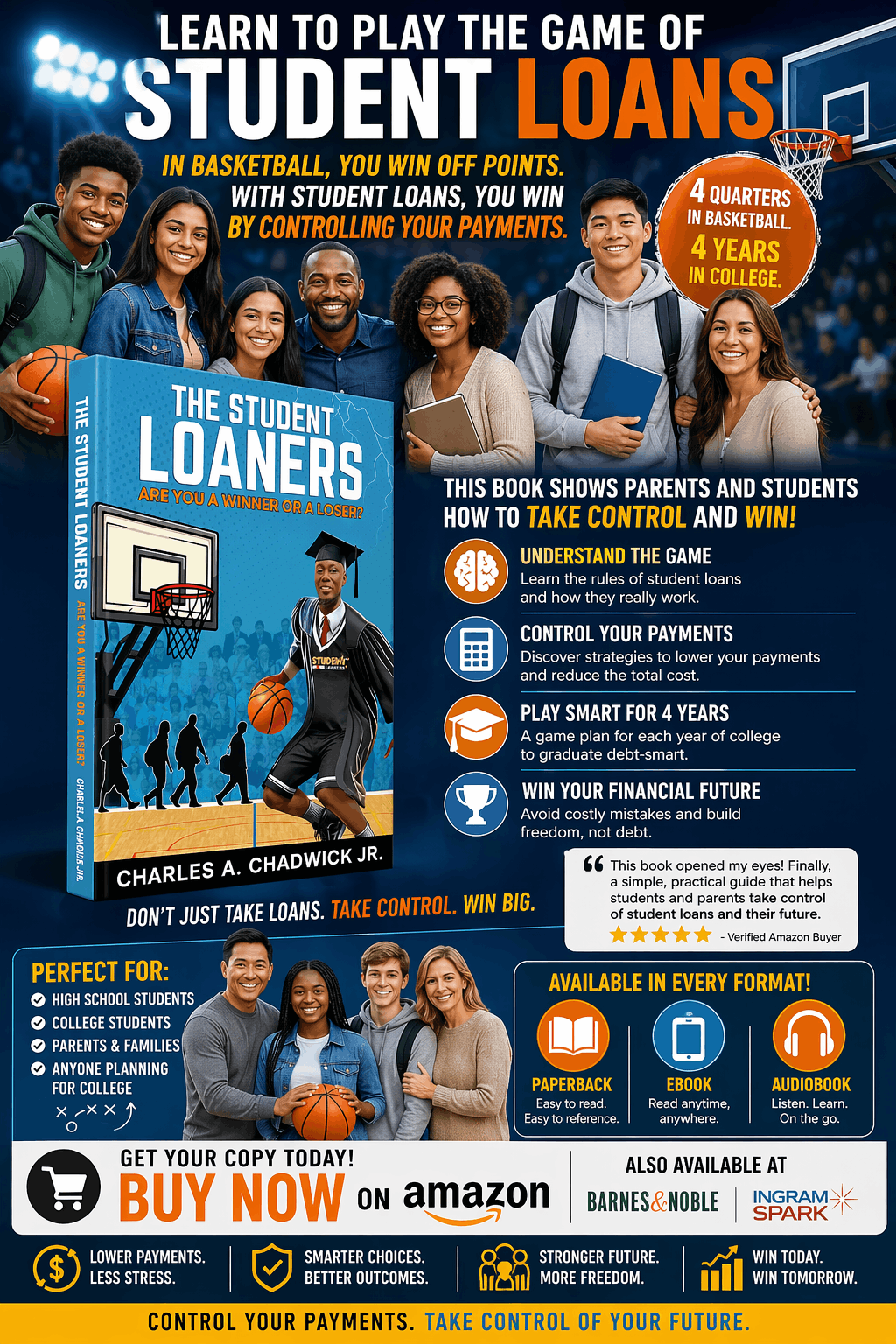
I wrote The Student Loaners: Are You a Winner or Loser? for this exact moment. I use basketball to show why signing a loan agreement should feel like studying the other team’s plays, not signing autographs.
What happens if you default on federal student loans
Missed payments have real consequences. Washington’s debates don’t pause them.
Depending on your situation, default can lead to:
- Damaged credit.
- Collection activity.
- Wage garnishment.
- Federal tax refund offsets.
The Department of Education explains the details in its federal student loan default guidance. If money is tight, call your servicer and ask about repayment options before you miss a payment. Waiting only makes it harder.
Defaulted loans are also changing hands. Read our post on Treasury taking over defaulted student loans to see what that means for borrowers.
Think about this for a second. What happens when someone earns a degree but can’t afford the loan payments that come with it? To me, success isn’t just graduating. Success is how well you handle money afterward.
Democrats and Republicans on student loans: where they differ
Both parties have real arguments, so let’s lay them out fairly.
Democrats generally push for more repayment help, stronger borrower protections and tougher servicer oversight. Courtney and Welch want interest set to 0%. Thompson wants a flat 2%.
Republicans generally stress controlling federal spending, restructuring repayment programs and limiting broad debt cancellation. They passed the 2025 law that created RAP and ended SAVE. Yet some Republicans, including Lawler and Luna, are also pushing a 2% interest cap.
Both sides deserve scrutiny. But I think both parties should answer a different question:
Why aren’t we teaching students how to avoid too much debt before they borrow?
Robert Kiyosaki’s book FAKE: Fake Money, Fake Teachers, Fake Assets also questions the quality of money education. I’d put it simply. Do students get real financial education before they sign for tens of thousands of dollars? Our post on why schools don’t teach money management covers that gap.
For years, leaders have argued over who should forgive student loans. Meanwhile, families keep making money decisions that last for decades.
Don’t just teach politics. Teach finances.
How I cut my college costs by about 40%
I didn’t wait for politicians to solve my college problem.
My father is a licensed plumber. When he refused to co-sign my student loans, I had to find another way. (He did me a favor, and I explain why in this post on why saying no to co-signing can be a gift.)
So I used the plumbing skills he taught me to help pay for school. I also used work-study, picked lower-cost courses and kept my living costs down. I even found a way to live on campus without paying regular housing costs.
Put together, those moves cut my college costs by about 40%.
Quick facts about my plan
Starting point: My dad, a licensed plumber, wouldn’t co-sign.
Result: About 40% lower college costs.
What I did: Used trade skills, work-study, lower-cost courses and smart living choices.
What I didn’t do: Wait on Congress, the president or a forgiveness program.
Keep in mind: These are my results. Yours will vary with your school, aid and situation.
You can learn how to earn while you learn in our guide to making cash in class through work-study.
I put the full system in a book. In Chadwick’s College Checklist, I show how to cut college costs by up to 40%, including how to live on campus for free, avoid extra fees and buy used textbooks.
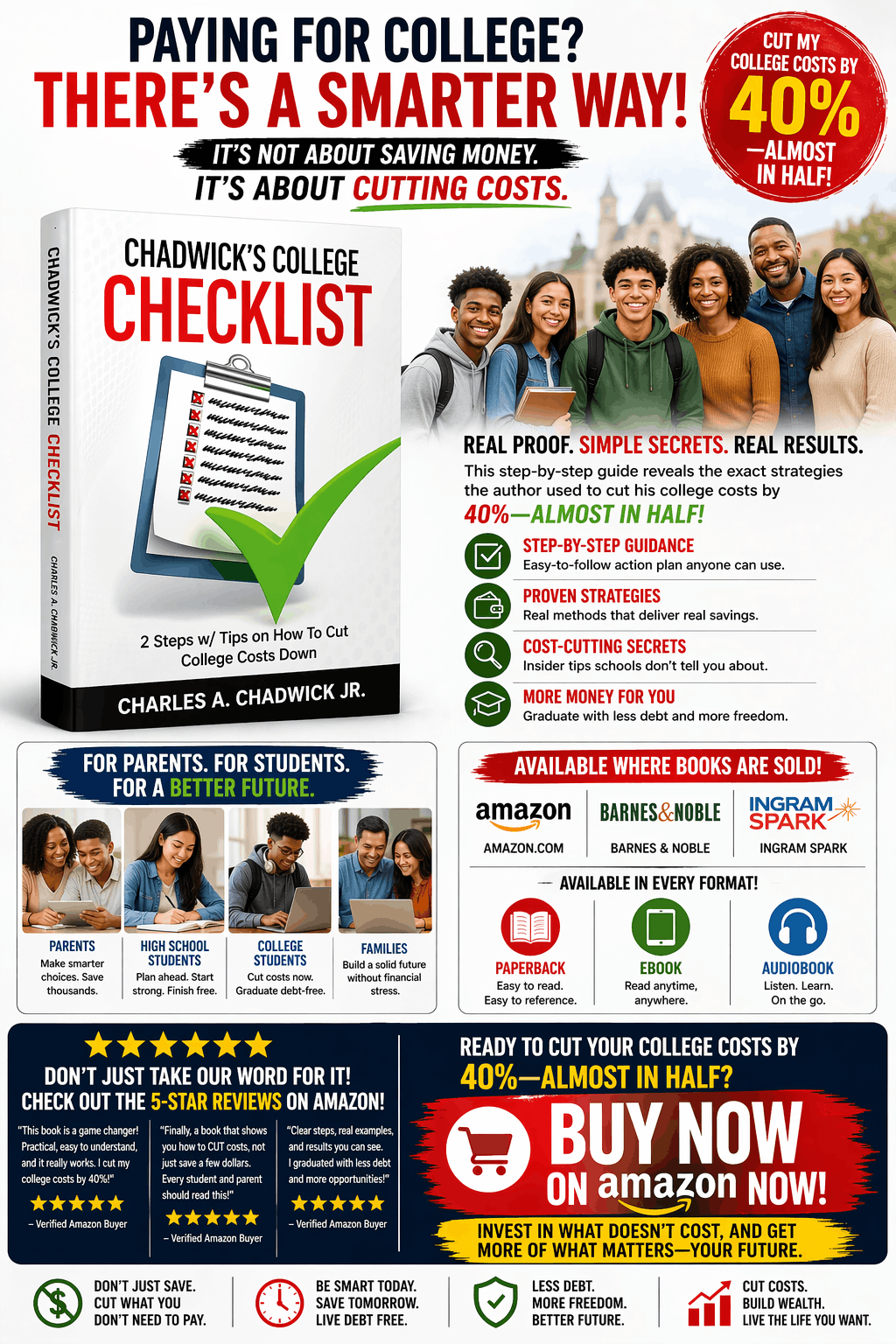
I call my mindset the Duality Mentality for the Economy. It means building a degree path and a hands-on skill at the same time, so you’re never stuck with only one way to earn.
College can open doors. Skills pay the bills.
Five financial lessons before you borrow
These five lessons answer a common question: how can you pay for college without loans? Use them before you sign anything.
1. Understand the total cost of college
Tuition is only one piece. Housing, books, meals, transportation, fees and interest add up fast.
Add up the full cost of attendance for each school. Then add the interest. Our guide on what to know before taking out student loans can help.
2. Learn a marketable skill
Plumbing, electrical work, welding and tech skills can bring in money before, during and after college. That income means you borrow less.
Not sure where to start? Read how to use a trade skill set to pay off student loans. My book Chadwick’s Cultivated Circumstances also shows how hands-on experience can raise your earning power.
3. Compare college costs before you enroll
Start with the FAFSA. Apply for grants and scholarships first, because they don’t need to be repaid. Then compare schools side by side.
Community college, transfer credits and work-study can all shrink what you borrow. See our take on how community college can limit debt problems.
4. Learn how loan interest and repayment work
Know the difference between federal and private loans. Know your rate, your repayment options, what forgiveness requires and what default does.
The forgiveness and interest bills in Congress cover federal loans. Private loans play by different rules.
5. Build a plan you control
Use real help programs when you qualify. PSLF is a good example, and here is the official PSLF page.
But don’t make a political promise your whole plan. Make a plan that still works if nothing changes in Washington.
What should borrowers do after the midterms?
Whatever Congress does next, stay active. Use this checklist:
- Log in to gov. Review your balances, interest rates, servicer and loan status.
- Confirm your repayment plan. If you were on SAVE, make sure you know which plan you’re in now.
- Call your servicer if money is tight. Ask about every repayment option before you fall behind.
- Check PSLF if you work in public service. Keep track of your qualifying payments.
- Plan for taxes if you expect forgiveness. Income-driven plan forgiveness can be taxable again.
- Don’t treat a bill as a law. A proposal in Congress hasn’t changed your loan until it’s signed.
- Watch the Nov. 18 response date. That’s when lawmakers asked Secretary McMahon to reply on servicing problems.
Final thoughts: don’t let politics become your financial plan
The 2026 midterms may bring more scrutiny of federal student loan policy. That’s good. Borrowers deserve accurate bills, fair treatment and answers.
But investigations alone won’t erase America’s student debt. And no election will pay your balance for you.
Parents and students need something that rarely gets airtime in political fights: financial education before the debt shows up. One of the best student loan strategies starts years before your first payment is due.
That’s our mission at Chadwick’s Experiences. We help you learn, earn and thrive by making smarter school and money choices.
Don’t just teach politics. Teach finances.
College can open doors. Skills pay the bills.
Join the conversation
Do you think Democrats and Republicans are doing enough for student loan borrowers? Or should schools and parents focus more on teaching students how to cut college costs before they borrow?
My question for you: would you rather hear a politician promise to forgive your loans, or learn strategies that help you avoid unnecessary debt in the first place?
Tell me in the comments.
